Combining Botox with Skin Tightening Devices: Synergy or Overlap?
Crow’s feet that soften after Botox yet still etch faint lines at rest. A jawline that looks sharper after radiofrequency tightening, but the smile still pulls the corners downward. If you work in aesthetics, you know this dance. Muscle-driven lines and laxity-driven folds rarely respect single-modality fixes. The question is not whether to combine Botox and skin tightening devices, but when the pairing creates true synergy and when it drifts into redundancy or risk.
What Botox does well, and where it falls short
Botox, and its peers in the botulinum toxin family, remain the most reliable way to reduce dynamic wrinkles. It interrupts acetylcholine release at the neuromuscular junction, weakening targeted muscles for roughly 3 to 4 months, sometimes longer in slow metabolizers. Where the toxin shines is predictable: frown lines, horizontal forehead lines, crow’s feet, bunny lines, depressor anguli oris overactivity that drags the mouth corners, chin dimpling from mentalis hyperactivity, platysmal bands, and select cases of nasal tip rotation control using the depressor septi nasi. The treatment can also reduce facial strain headaches in patients whose frontalis, corrugator, or temporalis over-recruit during stress.
Yet even precise neuromodulation does little for laxity, deflation, and dermal thinning. Static rhytids that persist at rest, etched primarily by collagen loss and skin creasing patterns, often outlive a well-executed Botox plan. This is where energy devices enter the conversation.
What tightening devices actually tighten
“Skin tightening” is a broad tent. High intensity focused ultrasound (HIFU) targets the SMAS and deep dermis with thermal coagulation points. Monopolar or bipolar radiofrequency heats the dermis botox and fibroseptal network for gradual tightening. Microneedling radiofrequency penetrates to variable depths, remodeling dermis while sparing the epidermis. Non-ablative lasers coax collagen turnover deeper in the dermis with controlled photothermal injury. Each platform exerts force on collagen and elastin architecture, not muscle. That distinction matters when planning around Botox.
Device protocols vary widely, but results usually evolve over 8 to 16 weeks as collagen matures. Compared to the fast onset of Botox, device outcomes are slow-build and often cumulative. When you architect a plan that places the toxin in service of the device (or vice versa), cadence is everything.
Where synergy is real
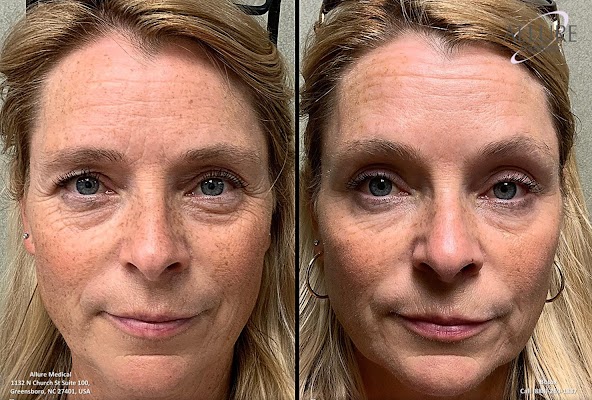
My best outcomes come when I treat the cause of a wrinkle at two levels. A patient with strong frontalis dominance, for example, creases the forehead to recruit elevation because the brow depressors overpower or fatigue. If I modestly relax the frontalis with Botox and pair it with radiofrequency microneedling to firm the prefrontal dermis, lines soften more completely and remain less visible even as the toxin fades. Another common scenario is periorbital creping. Crow’s feet improve with Botox, but the skin itself looks smoother 2 to 3 months after fractional or RF treatments that rebuild collagen. The two effects are different and complementary.
Botox also reduces fold-deepening behaviors during the collagen remodeling window. Patients unconsciously frown and squint less, which gives the device’s collagen stimulus a “quiet” environment. That dampening of repetitive shear forces improves the quality of collagen alignment, much like immobilizing a healing incision yields a finer scar.
When pairing turns into overlap
Not every combination makes sense. If a patient’s forehead lines are almost entirely dynamic and the dermis is thick with minimal laxity, adding a tightening device offers little beyond cost and downtime. A 28-year-old with expressive eyebrows and strong but healthy dermis can often achieve clean results with targeted Botox dosing strategies for expressive eyebrows and intelligent injection sequencing to prevent compensatory wrinkles. On the other hand, a 58-year-old with etched static lines and thin dermal thickness may see limited gains from Botox alone; here the energy device does the heavy lifting.
Overlap also shows up when non-specific device passes are used to “tighten everything” while the primary visual issue is muscle-driven. In those cases, the device masks the under-treatment of movement lines, then both results disappoint. Precision planning beats piling on modalities.
Order of operations: which first, and why
I prefer to stage devices and toxin with an eye on physiology and workflow. Thermal device sessions can cause transient edema and mild inflammation that alter landmark palpation. If you mark precisely for Botox using EMG or palpation, you want clean terrain. In most cases, I perform the device first and Botox about 7 to 14 days later. This allows swelling to settle, reduces the chance of spreading the toxin with post-device massage or lymphatic flow, and protects precision.
The exception is the hyperactive, animation-heavy patient whose muscular pull clearly distorts the tissue you plan to tighten. If glabellar overdrive pulls the medial brow down, a light preconditioning dose can stabilize the dynamic distortion, then the device session proceeds with more predictable tissue positioning. Dose conservatively to avoid overcorrection. In practice, this might be 10 to 14 units across corrugator and procerus for a new patient, always adjusted to muscle mass and response history.

Safety, diffusion, and the “don’t make it worse” rule
Synergy only matters if safety is impeccable. Toxin diffusion radius varies by injection plane and volume. Superficial intradermal microdroplets will spread less than deeper intramuscular boluses, but reconstitution techniques and saline volume impact radiant spread as well. A more dilute solution can travel farther, especially if injected quickly, so injection speed and muscle uptake efficiency are not just academic points. When I plan device sessions over recently treated regions, I assume that the functional zone of toxin effect is larger than the visible injection bleb. That guides post-care and massage instructions.
Migration patterns and prevention strategies hinge on respect for borders. Inject at least one centimeter above the orbital rim laterally when managing crow’s feet, angle superficially where intended, and avoid heavy massage for 24 hours. When pairing with periorbital tightening, I schedule the device first, give it a week, then place conservative lateral orbicularis oculi injections to limit smile-driven creasing without risking eyelid heaviness.
There is also a dosing caps per session safety analysis to keep in mind. While aesthetic doses are modest, stacking multiple facial areas in a single sitting can raise total units. In combination programs with device appointments, I prefer to keep each toxin session within conservative ranges, especially in smaller faces or in patients with thin dermal thickness and delicate periorbital anatomy.
Mapping muscles for device success
Subtle mapping pays off. I mark animation lines during high-speed facial video capture before any numbing or device gel, then replay in slow motion. This reveals impact on facial symmetry at rest versus motion and spots right-left variability. Many faces are asymmetric in neuromuscular junction density and muscle thickness. A right corrugator can dominate by 20 to 40 percent. That explains why the same dose on both sides sometimes yields uneven effects. When a device is layered on top, asymmetry may look like laxity mismatch rather than muscle imbalance. Adjust the toxin, not the energy settings, to correct it.
Actors, public speakers, and on-camera professionals need expressive range preserved. Treatment planning for actors and public speakers prioritizes the upper third of the face with selective “softening” rather than suppression. I tell them to expect small lift effects from dosing near the lateral tail of the brow and to plan filming around the 7 to 14 day window, when final toxin effect emerges. Devices can be scheduled earlier because they do not blunt micro-expressions.

Preventing compensatory wrinkles
If you paralyze the frontalis broadly, the brow depressors can dominate, creating heavy lids and compensatory lines near the nose, sometimes called scrunch or bunny lines. Injection sequencing to prevent compensatory wrinkles means placing microdoses in anticipated recruitments. A few units along the upper nasalis can keep the nasal scrunch in check. Perioral micro-injections can mitigate vertical lip lines without lip stiffness by targeting the superficial orbicularis oris at carefully spaced microdroplet points, which helps device-driven texture gains read cleanly rather than puckered.
Compensatory motion can also surface in the lower face as patients adjust speech patterns. Targeted mentalis and depressor anguli oris dosing can reduce chin strain during speech and soften a resting anger appearance, benefits that become more visible once the skin tightens and light reflects evenly.
Does tightening make Botox last longer?
Sometimes. Patients often report that Botox effects feel longer when a device improves the underlying skin quality. Mechanistically, the toxin duration is tied to receptor turnover, internalization, and nerve terminal sprouting, which are not directly altered by dermal remodeling. The perception of longer effect is more about reduced creasing against a healthier dermal matrix. There are real response differences between fast and slow metabolizers, and age and gender can predict effect duration to a degree. But device synergy primarily improves how the face looks as the toxin declines, not the pharmacodynamics of the toxin.
Reconstitution, units, and “creep”
Dosing ethics and overtreatment avoidance matter even more in combination care. Some injectors chase perfection by creeping units up at every follow-up. Over months, total neuromodulation increases and the face can lose character. Unit creep and cumulative dosing effects also raise theoretical risks for immunogenicity, especially with frequent top-ups. While modern preparations have low protein loads, antibody formation risk factors include very high cumulative doses, short retreatment intervals, and repeated booster sessions during the same cycle. In a combined program, I prefer to optimize injection point spacing and depth rather than simply add units. Precision mapping for minimal unit usage pairs nicely with device-driven collagen gains.
Saline volume during reconstitution affects spread and tactile feel during injection. A moderate dilution often yields smoother gradients with fewer peaks and valleys of effect, useful when you want subtle facial softening versus paralysis that complements tightening.
Depth and spacing: small choices, big differences
Botox injection depth comparison outcomes show that slightly more superficial placement in the frontalis can create a natural taper with less brow drop, especially in patients with high foreheads or strong frontalis dominance. Wider injection point spacing improves lift effects at the tail of the brow by preserving lateral frontalis fibers. If you intend to use ultrasound or RF around the temporal and lateral brow region, respect those preserved fibers to maintain lateral eyebrow tail elevation rather than flatten it.
Device passes also care about spacing. With fractionated RF microneedling, I vary energy and depth in zones where toxin will reduce movement. Over the glabella, I might keep passes light in patients prone to edema, then return for a second pass after Botox has settled to fine-tune texture.
Special populations and tricky variables
Long-term continuous use of toxin leads to adaptation. Some patients show influence on muscle memory over time, with baseline tone dropping. This can be helpful when pairing with devices; less shearing stress supports better collagen alignment. Others become more tolerant and require gradual dosing increases or adjusted intervals. Track outcomes using standardized facial metrics and photographs taken at consistent lighting, expression prompts, and camera distance. A visual scale of resting facial tone and motion symmetry helps you decide whether to adjust device energy or toxin map.
Athletes with high metabolic rates and lower body fat may metabolize toxin faster. Dosing adjustments for athletes often involve more frequent treatments rather than higher units, to avoid over-softening expressions. For patients after significant weight loss or gain, dosing adjustments consider altered fat pads and skin support. After weight loss, dermal redundancy can mask toxin results; device tightening becomes more valuable. After weight gain, heaviness creates different vectors that strain depressors; targeted toxin for balancing dominant depressor muscles can restore smile arc symmetry.
Patients on anticoagulated regimens can undergo both modalities with careful planning. Safety protocols for anticoagulated patients include icing, fine-gauge needles, minimized passes, and avoiding deep, rapid injections in vascular zones. Device parameters can be conservative, especially with needles that penetrate the dermis.
Connective tissue disorders complicate collagen response. Outcomes in patients with connective tissue disorders vary; device gains can be muted. Here, modest neuromodulation that reduces repetitive creasing may provide more visible benefit than aggressive tightening.
Prior filler history changes the landscape. Hyaluronic acid integrates with water and can conduct RF energy differently. I leave at least two weeks between filler placement and heating devices, prioritize lower energy near recent filler, and plan toxin separately to avoid misreading device edema as muscle asymmetry. Patients with prior eyelid surgery need careful brow management to avoid heaviness; a touch of toxin-induced lift combined with conservative periocular tightening can refresh without compromising eyelid mechanics.
Brow heaviness, ptosis history, and course correction
Post-treatment brow heaviness ranks among the most avoidable issues. It often stems from over-treating the central frontalis or placing units too inferiorly. Correction pathways include adding tiny doses to the brow depressors to rebalance vectors and waiting for partial recovery. When a device session is scheduled, delay it until weight on the brow improves, otherwise tightening may exaggerate the look of heaviness. Patients with prior ptosis history demand extra caution; lighter, higher injections and staged dosing reduce risk.
Nasal tip rotation control is niche but relevant. A tiny dose to the depressor septi nasi can let devices and fillers around the upper lip and columella frame work better. Poorly placed toxin in this zone risks smile changes, so proceed only with clear anatomical mapping.
Lips, chin, and the art of subtlety
Vertical lip lines arise from both skin quality and orbicularis oris overactivity. Device-based resurfacing or RF microneedling can tighten the dermis, while a few well-spaced microdroplets of toxin soften pursing. The key is avoiding lip stiffness. Under-treat, reassess in two weeks, and fine-tune after initial under-treatment rather than chase aggressive smoothing on day one. Upper lip eversion dynamics matter for speech and playing wind instruments; for professional vocalists, treatment planning for micro-expressions and articulation should err on minimalism.
Chin tension telegraphs fatigue and ages the lower face. Treating the mentalis reduces pebbly texture and softens the labiomental fold. Combined with submental tightening or monopolar RF for the jawline, the lower face can look fresher without the frozen look patients fear.
Will Botox hide micro-expressions too much for cameras?
Not if you plan right. Botox influence on facial micro-expressions is dose dependent and map dependent. On-camera professionals benefit from sparing the lateral forehead and leaving small windows of action in the tail of the brow and periocular region. Subtle lift effects can be achieved with injection refinement near the lateral frontalis, timed so that peak effect lands between major shoots. Devices can enhance texture and reflectivity without muting motion, so they are especially valuable for high-definition filming where skin quality reads as health.
Migration fears with post-treatment skincare, massage, or devices
Most migration happens at injection due to depth, volume, and speed. That said, vigorous massage or device heat over fresh injections is unwise. I advise avoiding strong massage, steam rooms, or heated workouts for 24 hours. If a device session must occur soon after toxin, keep it non-thermal and superficial, and avoid heavy pressure over treated zones. However, the cleaner path is scheduling separation: devices first, toxin second, with at least a week between.
Failure modes and how to rescue them
Treatment failure has distinct causes: inadequate units, inaccurate placement, antibodies, or misdiagnosis of the wrinkle’s cause. Antibody-induced resistance is rare, but if suspected after repeated non-response with a verified product and proper technique, consider switching formulations or extending intervals to reduce immunogenic pressure. More commonly, failure reflects a mismatch between dynamic and static components. If results were disappointing after Botox alone, add a tightening protocol; if devices seemed to do little, revisit muscle mapping. Rescuing asymmetry often requires minimal unit top-ups where motion persists and patience where edema or device remodeling confounds early reads.
Tracking outcomes over time
Objective tracking reduces guesswork. Standardized lighting, fixed camera distance, and expression prompts let you quantify changes in facial proportion perception, symmetry at rest versus motion, and the effect on facial fatigue appearance at the end of a workday. Some clinics integrate high-speed facial video to assess animation. Over a year, you can see whether long-term effects on muscle rebound strength produce easier maintenance or whether dosing recalibration after long gaps between treatments is required.
For maintenance, a common cadence is device sessions every 6 to 12 months, with Botox every 3 to 4 months for most regions, adjusted for response prediction using prior treatment data. Preventative facial aging protocols in younger patients focus on microdoses with extended intervals, plus occasional device passes for tissue health. Aesthetic maintenance programs work best when you plan the calendar up front and resist impulse add-ons.
Two quick checkpoints for real-world planning
- Ask yourself which component dominates each wrinkle: movement or matrix. If movement dominates, lead with Botox and reassess static residue before committing to device time. If matrix dominates, build the device plan first and use Botox to control shear forces during healing.
- Guard expression. Decide which micro-expressions matter for the patient’s identity and work, then protect those zones with lower doses and wider spacing. Let devices carry some of the load so the face stays communicative.
Final judgment: synergy, but only with discipline
There is genuine synergy when you line up Botox and skin tightening devices with a clear hierarchy. Toxin controls motion and reduces mechanical stress during collagen remodeling. Devices improve texture, elasticity, and the quality of the canvas that motion acts upon. The overlap problem appears when we treat everything everywhere without a map. Respect diffusion physics, plan the sequence, and measure what changes at rest versus in motion.
On a practical level, the most consistent wins come from three moves. First, precise marking using EMG or palpation to honor right-left variability. Second, conservative, well-spaced doses that soften rather than silence, especially in expressive foreheads and around the lips. Third, a device plan that targets laxity zones and etched lines, timed so swelling does not sabotage toxin placement.
Do this well and patients notice more than smoother skin. They describe less facial tension, fewer strain headaches after long days, and an easier smile arc that reads as kind rather than stern. That blend of comfort and aesthetics is the real selling point of the combination, and it is where synergy becomes obvious, not theoretical.

Public Last updated: 2026-01-20 07:36:17 AM