CNC Workholding Fixtures Explained: Boost Your Precision & Efficiency!
In CNC machining, the pursuit of precision doesn't stop at programming or toolpath strategies—it starts at the very foundation of the process: workholding. No matter how accurate your machine or sophisticated your tooling, if the workpiece isn’t firmly and correctly held in place, all other efforts risk being compromised. That’s why getting your CNC workholding fixtures right is crucial to achieving high-quality, high-efficiency results—every single time.
At SilverCNC, we believe versatility and accuracy begin with rock-solid workholding. Our customers across industries—from aerospace to prototyping job shops—know that the difference between a successful part and a scrapped one often comes down to how well it's fixtured during machining.
What are CNC Workholding Fixtures?
CNC workholding fixtures are mechanical devices or systems designed to securely support and position a workpiece during machining operations. Their primary purpose is to:
- Hold the part firmly in place
- Maintain consistent location relative to the machine’s coordinate system (datums)
- Allow full access to machining features without obstruction
In essence, a good fixture ensures that your parts are:
- Secure: Not moving/vibrating during cutting
- Repeatable: Positioned the same way for each run
- Accessible: Visible to the cutting tool without interference
From a simple vise to custom-built modular fixtures, the goal remains the same: controlled, accurate, and repeatable workholding.
Types of CNC Workholding Fixtures
At SilverCNC, we categorize CNC workholding fixtures into various types based on their function and machine compatibility.
🧰 1. Vises
- One of the most versatile forms of workholding
- Available in manual, hydraulic, or pneumatic variants
- Self-centering vises are ideal for symmetrical part positioning
- Best for small batch parts, prototyping, and light production
🔩 2. Modular Fixtures
- Built from standardized components (plates, locators, clamps, etc.)
- Fully customizable and reconfigurable
- Ideal for shops that run varied parts regularly
- High ROI due to reusable components
🧱 3. Dedicated Fixtures
- Custom-made for a specific part or family of parts
- Offers high stability and lowest cycle times
- Best suited for mass production or complex contour parts
🔄 4. Vacuum Fixtures
- Use suction to hold flat parts or non-ferrous materials
- Great for sheets, plastics, or delicate materials that can’t be clamped
- Requires a good vacuum system and clean sealing surface
⚙ 5. Magnetic Fixtures
- Use permanent or electro magnets to hold ferrous materials
- Suitable for odd-shaped or thin parts
- Fast setup and repositioning
🔧 6. Rotary/Indexing Fixtures
- Work in conjunction with rotary tables or 4th-axis setups
- Help machine multiple faces without resetting the part
- Essential for angular indexing and cylindrical part holding
How CNC Workholding Fixtures Boost Precision and Efficiency
Let’s break down the specific advantages CNC workholding fixtures bring to your machining process.
✅ 1. Removes Setup Variability
Manual clamping or eyeballing part positioning introduces inconsistency.
Fixtures maintain:
- Exact X/Y/Z positioning
- Defined rotation (angular index)
- Repeatability across setups and shifts
✅ 2. Reduces Workpiece Movement
Secure and rigid clamping means fewer vibrations and better surface finish. This directly:
- Increases dimensional accuracy
- Enhances tool life
- Improves overall quality consistency
✅ 3. Speeds Up Part Changeover
Modular or quick-release fixtures let operators:
- Load/unload parts faster
- Swap parts with minimal adjustments
- Repeat jobs seamlessly using preset locations
✅ 4. Enables Multi-Part Machining
With custom or modular fixtures, you can hold:
- Multiple identical parts at once
- Multiple operations (OP1, OP2) in a single setup
- Mirror or nested parts for simultaneous machining
- More parts per cycle = fewer spindle stops = more profit.
✅ 5. Automates Complex Workflows
In advanced CNC systems:
- Fixtures can be integrated with automation (robots, pallet changers)
- Downtime between jobs is eliminated
- Consistency is maintained shift after shift
Design Considerations for Workholding Fixtures
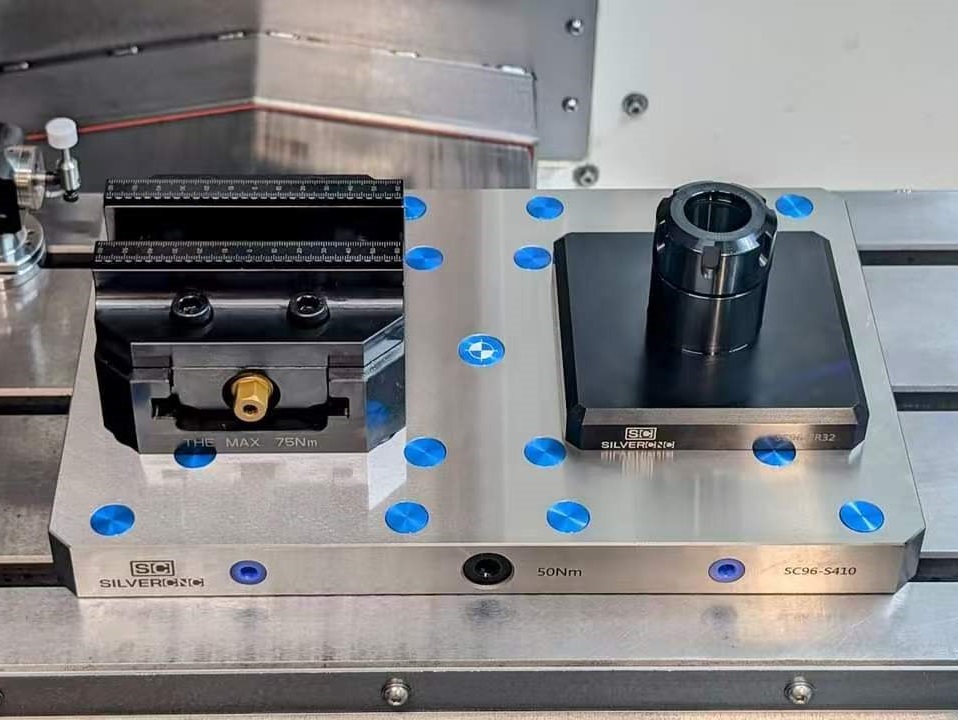
Putting clamps and locators on a plate doesn’t make a fixture. Effective fixturing requires engineering insight, and at SilverCNC, we use the following best practices:
🎯 1. Datum Alignment
Ensure the fixture interfaces with the correct part datums (location surfaces), maintaining alignment across runs.
🪛 2. Clamp Direction and Balance
Place clamps so that:
-Forces push the part into locators
-The part doesn’t lift or slide under tool pressure
🛠 3. Material Compatibility
Choose fixture materials based on:
-Part material hardness
-Coolant and chip conditions
-Tolerance wear resistance (steel vs. aluminum vs. plastic)
📐 4. Chip Evacuation
Design for easy access to machined features and allow space for chip removal without clogging the fixture.
⚖ 5. Accessibility and Tool Clearance
Avoid obstructing tool paths or creating hard-to-machine blind zones.
Best Practices for Using CNC Workholding Fixtures
Looking to maximize ROI on your fixtures? Here are Silvercnc’s top tips:
🔹 Keep It Simple
Avoid over-complicating your fixture unless absolutely necessary. The simpler the setup, the faster the changeover.
🔹 Use Standardized Components
For modular setups, use standardized fixture elements to ensure parts and assemblies are easily replaceable.
🔹 Label Everything
Use etched template numbers, part zones, or locator keys to prevent assembly errors.
🔹 Maintain Fixtures Regularly
Clean after each use. Check for wear or misalignment. Coat with rust-resistant lubricant if stored.
🔹 Use Dual-Operation Fixtures
Run OP1 and OP2 in the same fixture layout to reduce programming and refixturing time.
Why Choose Silvercnc CNC Workholding Fixtures?
At Silvercnc, we provide high-precision CNC workholding fixtures designed for performance, repeatability, and efficiency. Our solutions offer:
✅ Hardened and ground surfaces for long-lasting precision
✅ Modularity for flexible use across different parts and platforms
✅ Compatibility with all major machine brands and rotary tables
✅ Custom fixture design on request for niche or complex applications
✅ Quick-turn manufacturing and support for critical project timelines
Whether you're machining aluminum prototypes, steel shafts, or finished titanium parts, our solutions are built to support high-performance operations on your shop floor.
Precision Starts with Fixturing
If your parts are shifting, setups are taking too long, or tool paths are inconsistent, there’s a good chance the problem isn’t your machine or program—it's your fixturing.
Adding the right CNC workholding fixtures doesn’t just improve a single operation—it accelerates your entire production process. From improving dimensional repeatability to maximizing spindle uptime, workholding is a foundational pillar that impacts every result your machine delivers.
Frequently Asked Questions (FAQ)
Q1: Can I use one fixture for multiple parts?
Yes—with modular or adjustable design, a single fixture base can support different part types or sizes.
Q2: What’s the difference between modular and custom fixtures?
-Modular fixtures use standardized, reconfigurable components.
-Custom fixtures are built for one specific part or operation.
-Modular = flexibility; custom = speed and repeatability.
Q3: How do I clean and maintain my fixtures?
Wipe off chips and coolant after use. Clean threads and sliding surfaces. Keep locators free of burrs. Apply rust inhibitors for long-term storage.
Q4: Can a CNC workholding fixture be used with robotic automation?
Absolutely. Silvercnc fixtures can be integrated with pallet systems, robotic arms, and quick-change bases for uninterrupted, lights-out machining.
Q5: What if I’m not sure which fixture is right for my job?
Contact us! We offer free consultations and application-specific advice to pair you with the ideal solution for your machine, material, and part geometry.

Public Last updated: 2025-12-04 07:23:56 AM